

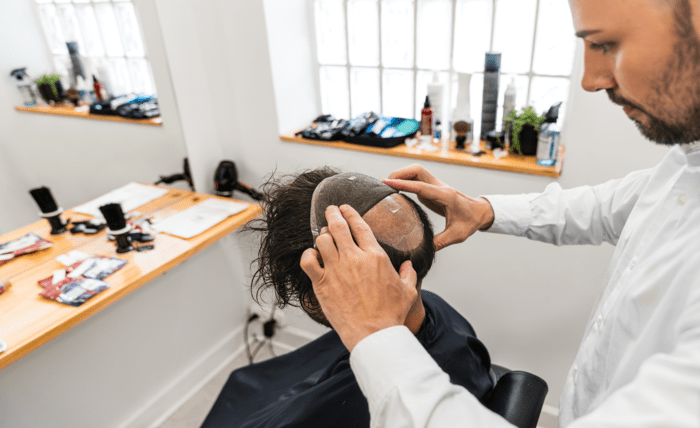
The best hair replacement for men depends on the extent and pattern of hair loss, the amount of viable donor hair available, the desired level of coverage and whether surgery fits the person’s preferences and circumstances.
Men considering the best hair replacement for men in Sydney generally have two broad approaches to compare. Non-surgical hair replacement uses a customised hair system to provide coverage, while hair transplantation surgically relocates existing follicles from one area of the scalp to another.
The key difference is where the replacement hair comes from. A non-surgical system adds hair externally, whereas transplantation depends on the person having sufficient healthy donor follicles. Understanding that distinction makes it easier to compare coverage, timing, maintenance and long-term expectations.
Start by Understanding the Cause of Hair Loss
Before comparing replacement options, it is important to understand why the hair is thinning.
Male pattern hair loss, also known as androgenetic alopecia, typically develops gradually. Healthdirect Australia explains that it commonly begins with recession around the temples and hairline before progressing to thinning around the crown. Hair follicles in affected areas gradually produce shorter and finer hairs.
Not every form of hair loss follows this pattern. Autoimmune conditions, infections, illness, stress and other factors can also contribute to thinning or shedding.
Sudden hair loss, distinct bald patches, scalp changes or unexplained shedding should therefore be assessed by an appropriate health professional before cosmetic or surgical replacement is considered.
Once the cause and likely progression are understood, it becomes easier to determine what kind of coverage is realistic.
How Does Non-Surgical Hair Replacement Work?
Non-surgical hair replacement uses additional hair attached to a lightweight base that is fitted over areas affected by thinning or baldness.
Depending on the system, the replacement hair can be blended with remaining natural hair and customised according to characteristics such as:
- Hair colour
- Texture
- Density
- Length
- Hairline appearance
- Preferred hairstyle
- Size and location of the area requiring coverage
Hairpieces and hair systems can be used for different types and stages of hair loss. DermNet notes that they provide an immediate cosmetic result, whereas biological treatments and transplantation can take substantially longer to produce visible changes.
This makes non-surgical replacement particularly relevant when immediate coverage is an important priority.
Non-Surgical Systems Do Not Depend on Donor Hair
One of the most important differences between the two approaches is donor availability.
A hair transplant can only redistribute follicles that already exist. Someone with extensive thinning may not have enough suitable donor hair to create the density they want across a large area.
A non-surgical system does not have the same limitation because the replacement hair is supplied by the system itself.
This allows the density and coverage to be planned according to the desired appearance rather than being restricted by the number of follicles available for transplantation.
It also provides flexibility if hair loss progresses. The system can potentially be adjusted or replaced with a different size, density or style as requirements change.
What Maintenance Does a Hair System Require?
Immediate coverage does not mean maintenance-free coverage.
The practical commitment depends on the system, attachment method, lifestyle and amount of natural hair being integrated. Ongoing care may involve cleaning, attachment maintenance, styling, professional servicing and eventual replacement.
Before choosing a system, ask:
- How frequently will servicing be required?
- How should it be washed and styled at home?
- Can it be worn during exercise?
- How does swimming affect maintenance?
- How long does the system typically remain usable?
- What happens as natural hair underneath continues to grow?
- Can the density or hairstyle be changed later?
A person who swims frequently or exercises heavily may have different requirements from someone with a less active routine.
The best non-surgical option is therefore not simply the system that looks most realistic during a fitting. It needs to remain manageable within everyday life.
How Does Surgical Hair Replacement Work?
Hair transplantation involves moving existing hair follicles from areas of stronger growth to areas affected by thinning or baldness.
Healthdirect describes hair transplantation as cosmetic surgery in which follicles are transferred from areas where hair is thicker to areas where hair has been lost. Suitable donor hair is necessary for the procedure.
After transplantation, the follicles need time to establish and begin producing hair in their new location.
DermNet notes that the transplanted hairs commonly shed after the procedure and may not begin regrowing for one to three months. The final result develops progressively rather than producing immediate coverage.
This is an important practical difference for someone deciding between a system and surgery.
Donor Supply Limits Surgical Coverage
A transplant redistributes hair rather than creating new follicles.
This means the surgeon has a finite supply of donor hair to work with. The amount, quality, colour and texture of the donor hair can influence how much coverage can realistically be achieved. Healthdirect specifically identifies healthy donor hair as an important consideration when determining whether transplantation is suitable.
Someone with a relatively small area of loss and strong donor density may have different surgical possibilities from someone with advanced thinning across much of the scalp.
Future hair loss also needs to be considered.
DermNet notes that balding in untreated areas can continue after transplantation. A transplant therefore needs to be planned around the likely long-term pattern rather than only filling the areas that are currently thin.
Hair Transplantation Involves Surgery and Recovery
Hair transplantation is a surgical procedure, so potential complications and recovery need to form part of the decision.
Healthdirect advises that transplantation can carry risks including infection and scarring, while DermNet also lists potential complications such as bleeding, pain, numbness, swelling, poor graft growth and an unnatural appearance.
Anyone considering transplantation should have an individual consultation with an appropriately qualified medical practitioner.
The consultation should cover donor availability, expected density, the proposed technique, recovery, possible complications and how future hair loss might affect the result.
Before-and-after photographs can demonstrate previous work, but they should not be treated as a guarantee. Donor density, scalp characteristics, hair texture and the extent of loss differ between individuals.
Non-Surgical vs Surgical Hair Replacement
The two approaches solve the appearance of hair loss in fundamentally different ways.
Non-surgical hair replacement:
- Provides coverage once the system is fitted
- Does not require viable donor follicles
- Avoids surgical recovery
- Can be customised for density, colour and style
- Can be adjusted as hair loss or preferences change
- Requires ongoing cleaning, servicing and eventual replacement
Hair transplantation:
- Uses the person’s existing follicles
- Requires adequate donor hair
- Involves a surgical procedure and recovery
- Produces results gradually as transplanted follicles grow
- Is limited by available donor supply
- Needs to account for future loss of non-transplanted hair
Neither list automatically makes one approach better. They simply represent different compromises.
Who Might Prefer Non-Surgical Hair Replacement?
A non-surgical system may be worth considering when someone:
- Wants immediate visible coverage
- Prefers not to undergo surgery
- Has limited donor hair
- Has extensive thinning requiring substantial coverage
- Wants flexibility to change density or hairstyle
- Is comfortable with ongoing maintenance
The ability to determine the appearance of the replacement hair is one of the main practical benefits.
A consultation should still establish realistic expectations about attachment, servicing and the way the system integrates with existing hair.
Who Might Consider Hair Transplantation?
Transplantation may be worth discussing when someone:
- Has an appropriate pattern of hair loss
- Has sufficient healthy donor follicles
- Wants growing hair rather than an external system
- Understands that results take time
- Accepts the risks and recovery associated with surgery
- Has realistic expectations about achievable density
Healthdirect emphasises that hair transplantation is not appropriate for everyone and recommends discussing the likely benefits and risks with a doctor.
A medical assessment is particularly important before making an irreversible surgical decision.
Consider Long-Term Cost and Maintenance
The initial price does not provide a complete comparison.
Non-surgical systems involve ongoing costs associated with maintenance, servicing and replacement. Transplantation has a larger surgical cost upfront and may require more than one session, particularly when a greater amount of coverage is required. Healthdirect notes that multiple transplant sessions may be necessary.
Future hair loss may also change what is required.
Comparing the likely costs and maintenance over several years provides a more realistic basis for deciding which option fits individual priorities.
Choosing the Best Hair Replacement for Men
The best hair replacement for men cannot be identified by asking whether surgical or non-surgical treatment is generally better. The more useful question is which approach best matches the individual’s hair loss, donor availability, desired coverage and willingness to commit to surgery or ongoing system maintenance.
Non-surgical hair replacement can provide immediate, customisable coverage without depending on donor follicles, but it requires regular care and eventual replacement.
Hair transplantation provides the opportunity for transplanted follicles to produce growing hair, but coverage is limited by donor supply and develops gradually after surgery.
Understanding these differences before choosing an option helps set realistic expectations and makes it easier to select a solution that fits both the desired appearance and everyday lifestyle.