

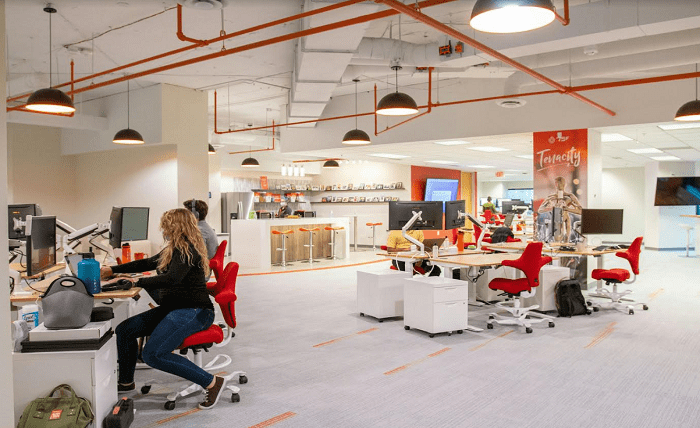
Businesses navigating the ever-evolving dynamics of modern workplace environments recognize that seamless integration has become paramount to workplace efficiency. Of the various contributors, technology takes center stage – particularly coworking spaces which facilitate professional collaboration while creating an atmosphere conducive to flexibility and connectivity.
In our exploration of smart office solutions, we investigate this intersection where efficiency meets innovation; coworking spaces offer such an innovative solution as they allow professionals to come together under shared workspace conditions fostering unique blends of flexibility and connectivity that have quickly grown in popularity over recent years.
The Evolution of Smart Office Solutions
The journey of smart office solutions began with the automation of routine tasks. The current technological landscape has witnessed more sophisticated approaches. Automation tools have evolved into intelligent systems capable of understanding and responding to specific business requirements, saving both time and creating environments tailored specifically for employees’ evolving demands. These intelligent solutions also contribute to creating environments tailored specifically towards workforce needs and developing employee environments tailored for them.
At first, smart office solutions focused on streamlining basic processes. Automation tools handled repetitive tasks efficiently so employees could concentrate more fully on more challenging responsibilities. Over time, however, smart office solutions evolved into intelligent systems capable of analyzing data patterns, learning from patterns, and adapting seamlessly into diverse organizations’ unique workflows.
Intelligent Systems: Redefining Workflows
Smart office solutions extend beyond mere automation, incorporating intelligent systems that redefine how tasks are executed. Take, for instance, smart lighting systems that adjust to the needs of the workforce, reducing energy consumption while enhancing security. By automating repetitive processes and optimizing lighting conditions, businesses can significantly enhance operational efficiencies. Shop around and compare texas average electricity rates from different providers, you can potentially find lower electricity prices than those offered by traditional, regulated markets.
In addition to smart lighting, advanced office solutions encompass a broader spectrum of technologies. These include AI-driven algorithms that predict workflow patterns, enabling proactive adjustments to enhance efficiency. Such systems contribute not only to streamlined processes but also to the creation of dynamic work environments that respond to the real-time needs of employees.
Balancing Efficiency and Human Ingenuity
Automation offers many benefits; however, to achieve maximum effectiveness it must also maintain human connections. Implemented thoughtfully, smart office solutions allow employees to focus their energies on tasks that demand creativity and critical thought rather than administrative duties that could otherwise distract from these essential activities. The integration of technology should complement human capabilities, creating an environment where innovation and efficiency coexist harmoniously.
Striking this balance involves understanding the intricacies of each task. While automation handles routine and repetitive processes, human intervention remains invaluable for tasks demanding emotional intelligence, creativity, and strategic decision-making. The collaboration between human expertise and technological efficiency forms the core of an optimally functioning smart office environment.
Connectivity for Enhanced Collaboration
Seamless internet connectivity forms the cornerstone of smart office solutions, facilitating information flow across the digital landscape. But beyond technical aspects like speed, connectivity encompasses teams remaining connected. When teams remain interlinked in an office with excellent internet connections, virtual meetings run smoothly, files are shared instantly with all parties involved and collaboration transcends geographical barriers.
Connectivity isn’t simply a technical necessity – it plays an instrumental role in cultivating an inclusive work environment, connecting scattered locations seamlessly so they can collaborate on projects, share insights, and engage in real-time dialogues. Robust connectivity not only fosters operational efficiency but also builds team cohesion even when geographically separated.
Future-Proofing Strategies
The rapid pace of technological advancements requires businesses to adopt future-proofing strategies. It involves not just embracing current technologies but staying informed about emerging ones. Future-proofing goes beyond purchasing cutting-edge tools; it involves creating an environment where employees feel equipped to navigate an ever-evolving digital sphere. This approach ensures long-term stability and a culture of continuous learning within teams.
Future-proofing strategies also encompass the ability to adapt to evolving technological landscapes. This includes developing a workforce with the skills to navigate new technologies seamlessly. Businesses that prioritize continuous learning and adaptability are better poised not just to react to technological advancements but to also leverage emerging tools for long-term success.
Conclusion
Integration of smart office solutions has become essential to business’ sustained success and expansion. From collaborative tools and intelligent systems to streamlining processes and improving connectivity, these technological journeys create lasting business impact by increasing workplace productivity. Adopting such solutions creates the optimal work environment where innovation thrives while tasks are completed efficiently while equipping employees for digital success.