

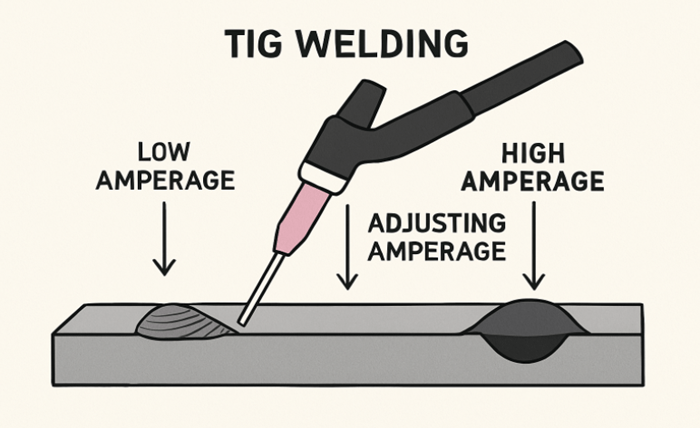
Tungsten Inert Gas (TIG) welding is a process that relies on precise amperage control and expert heat management to achieve high-quality welds. The relationship between amperage and heat is crucial for weld quality, affecting bead appearance and structural integrity. Misunderstanding can lead to weak joints, spatter, warping, or burn-through, causing costly rework or product failures. To refine one’s craft, guidance from authoritative sources is essential. The TIG Welding Guide provides practical advice and expert insight on elevating every aspect of the TIG welding process. Mastering these skills leads to visually striking results and reduces defects like porosity and structural weakness.
Understanding Amperage in TIG Welding
Amperage, measured in amps, is the electrical current passing between the tungsten electrode and the workpiece in TIG welding. It is directly tied to the heat generated at the weld pool, determining the depth of the arc penetration and uniform fusion with the joint. Too little amperage results in weak beads, while too much can cause burn-through, warping, and a large weld pool. Mastery of amperage control requires understanding external variables like material temperature, joint fit-up, and wind or draft.
Factors Influencing Amperage Selection
Material thickness is crucial in selecting amperage for welding, as thinner materials require more energy to heat deeper areas and ensure full fusion. Excess amperage on thin metals can cause damage, making precise control essential for delicate work. Different materials have varying heat conduction capacities, with aluminum requiring higher initial amperage for effective penetration and fusion, while stainless steel maintains heat more locally. Joint configuration also affects heat transfer and retention during welding, with some types requiring adjustments to maintain a consistent bead and avoid imperfections. Good welders understand joint design and make ongoing adjustments to maintain ideal heat application parameters.
Techniques for Effective Heat Control
Heat management in TIG welding is crucial for maintaining the workpiece’s metallurgical integrity and achieving clean, beautiful weld beads. Techniques like pulse welding, travel speed, and arc length control are essential for superior thermal control. Pulse welding allows deep penetration while maintaining arc stability and allowing metal to cool between pulses. Travel speed is crucial for dictating heat delivery, with rapid movement on thin sheets and slowing for thicker parts. Arc length control affects heat focus and distribution, with closer tungsten resulting in a smaller, more direct arc, and longer arcs spreading heat and increasing heat-affected zones.
Equipment Features Enhancing Heat Management
Modern TIG welders have advanced features that improve heat and amperage management in welding projects. These include AC Balance Control, which adjusts the duration of positive and negative cycles for reactive metals like aluminum, ensuring a contaminant-free weld and minimizing tungsten balling. The TIG foot pedal, acting as an accelerator, provides real-time control over amperage, allowing welders to adapt to joint thickness or fit-up changes, making it essential for complex assemblies or variable-thickness projects. Combining these technologies with the right technique can transform a good weld into an exceptional one.
Common Challenges and Solutions in Heat Management
Even highly skilled welders encounter challenges with heat control that can threaten weld quality if not properly addressed. Fortunately, several proven techniques exist to mitigate these problems based on material thickness and project requirements:
- For Thin Materials: Operating at minimal amperage is vital. Setting your machine to the lowest effective current and pairing this with quick travel and pulse welding will reduce the total heat input. Tack welding at multiple points can counteract distortion during the final weld, keeping the joint securely aligned and reducing post-weld straightening efforts.
- For Thick Materials: A higher starting amperage, often paired with preheating, becomes necessary when faced with substantial cross-sections. Beveling joint edges aids in achieving deep penetration and fusion at the root, while gradual cooling procedures can help minimize residual stresses and avoid unwanted cracking.
Conclusion
Achieving excellence in TIG welding requires a deliberate focus on two intertwined variables: amperage and heat input. By mastering how these factors interact, along with leveraging modern equipment features and time-tested techniques, welders produce work that is structurally sound and visually impressive. Staying abreast of ongoing innovations, informed by trusted resources, will empower welders of any experience level to deliver projects that stand up to the highest fit, finish, and durability standards.